Sanitary Cheese Preserver
Homestead Kitchen
Original post: July 7, 2019 Last Updated: December 31, 2025
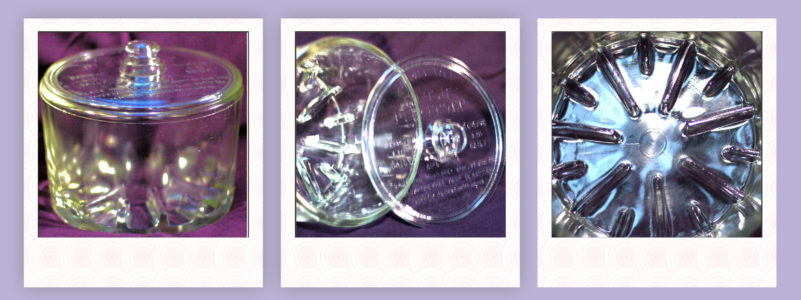
This is a Sanitary Cheese Preserver. It is a thick glass chamber with portions raised in the bottom to hold cheese out of the mixture of vinegar, salt, and water that was believed to help preserve the cheese. The lid is also glass and has a rim that sets loosely on the cheese chamber. The original cheese preservers were made by U.S. Glass Company from 1928 up until around 1939. From about 1940 until 1953 they were made by The Cambridge Glass Co. of Cambridge, Ohio. The mould for the cheese preserver was owned by Carl Tanner & Co. of Alliance, Ohio. Carl Tanner & Co. were manufacturers and dealers in cheese.
This particular preserver is about 7-5/8” wide across the top and tapers to about 7” wide at the base. It is approximately 6-1/2” high with the lid attached. The top says to remove lid daily. Place one third pint vinegar and one tablespoon full salt in the bottom, slightly diluted with water.
There were three sizes of preservers manufactured. Two were home sized models (the 1-1/2 lb. and 3 lb. sizes) and one was a commercial sized model for a 30 lb. cheese. Additionally, the home sized models came in round and square shapes. The square shaped preserver was introduced around 1940. The mould for the 30 lb. preserver was not believed to be owned by Carl Tanner & Co. and research could not indicate who owned the mould.
There were several complaints regarding the cheese preserver. One was the growth of mold on the cheese. The cheese preserver was meant to be kept in a cool place and some information reveals that the preserver should have been stored within the refrigerator or a cool basement. Some indications showed that the acidity of the vinegar played a part in whether the cheese became moldy. White vinegar was preferred over apple cider vinegar. Other information led to the conclusion that mild new cheese (not aged) had a higher moisture content and therefore molded more quickly. Processed cheese was not suited to the preserver because of other ingredients in addition to milk.
Another complaint was the taste of the cheese was tainted (probably from the vinegar). When stored in the refrigerator, the lid would collect moisture and drip on the cheese giving the cheese an off flavor. The company also indicated that the lid needed to be removed daily for the cheese to receive fresh air. It was believed that the home consumer would not raise the lid daily and that the moisture collection was from removing the preserver from a cool area (like the refrigerator) to a warm area and then returning to the cool area.
Lastly, there were complaints that the jar took up too much room in the refrigerator, which was countered with the fact that the jar could be kept in a cool pantry, kitchen or basement.
All in all, the preserver was on the market for about 25 years and by the early 1950’s was seeing the end of its market to consumers.
The cheese preserver at Pioneer Mountain Homestead is not utilized, but simply a conversation piece to be enjoyed. Because milking goats are raised at the Homestead, dairy is celebrated. Old dairy items such as this one are collected and preserved as a part of history.
Thank you so much for your support!
We are full time homesteaders at Pioneer Mountain Homestead in the Appalachian Mountains of south-central Pennsylvania. We have a sawmill, produce garden, honeybees, layer hens, laying ducks, pigs, and goats. We provide boat and camper storage to nearby visitors of Raystown Lake and sell firewood and lumber in south central Pennsylvania. Our journey is to be as self-reliant as we can be; to live as much as we can from the resources we have at hand; to effectively be productive with as minimal environmental impact as possible; to raise food in an organic manner; and to give back to our community through education or demonstration. We are always learning, as well. Life is always an adventure! We enjoy learning from others and seeing what other people are doing as well. – Bren and Chuck
Disclaimer: Pioneer Mountain Homestead blogs, vlogs, opinions, and videos are for entertainment purposes only. Always read and understand safety guidelines when using any information shared by Pioneer Mountain Homestead, LLC.
Other products or information you may be interested in:


Disclosure of Material Connection: Some of the links in this page or post may be “affiliate links”. This means that if you click on the link, Pioneer Mountain Homestead, LLC may receive an affiliate commission at no direct cost to you. Pioneer Mountain Homestead, LLC only recommends products or services that the owners, managers, or employees of Pioneer Mountain Homestead, LLC use or believe will add value to the readers of this website. This disclosure is made with the Federal Trade Commission’s 16 CFR, Part 255: “Guides Concerning the Use of Endorsements and Testimonials in Advertising.”